Why Vardhman Textiles' Quality Standards Aren't Just a Spec Sheet
I believe Vardhman's biggest differentiator isn't its production capacity—it's the consistency of the product you actually receive.
After four years of reviewing textile deliveries, I've rejected about 9% of first shipments in 2024 alone. The usual culprits? Inconsistent dye lots, unexpected pilling in what was supposed to be a premium acrylic blend, and tolerance drift between production runs. Vardhman isn't perfect, but they handle this better than most vendors I've dealt with. And that's not just about specs—it's about how your customer perceives your brand based on what they touch.
The most frustrating part of buying yarn at scale: you can nail the price and miss the quality, and your client doesn't care about your contract terms. They care that the 'glimmer knit fabric' you sold them looks dull by the third wash. I've seen it happen. That reputational damage is harder to fix than a rejected batch.
It took me about three years and roughly 200 orders to understand this.
I didn't fully grasp the link between production consistency and client retention until a $22k order of baby soft yarn came back wrong. The spec said 'acrylic blend, superwash.' The fabric felt fine initially, but after two cycles—visible shrinkage. That wasn't Vardhman's fault; it was a third-party subcontractor. But guess who the client blamed? Me.
So why Vardhman? They've got a public company structure with standardized processes. Their Cotton Plus line, for instance, has a tighter tolerance on twist per inch than many competitors. I've seen their lab reports. They don't just publish a spec sheet; they audit in production. That might seem obvious, but you'd be surprised how many mills don't.
People think expensive yarn equals better quality. That's not quite right.
The assumption is: higher price means better fiber, better spinning, better dye. In reality, some mid-range vendors produce more consistent results than premium ones, because they've optimized for repeatability rather than showcasing their best possible run. I've run blind tests with our design team: same pattern, same machine, two different lots of 'high wool' yarn. One produced a 2.3% weight variance; the other, 5.1%. The cheaper one was actually more consistent.
Vardhman sits in an interesting spot. They're not the cheapest, but they're not the most expensive either. Their value proposition is: you get what's on the label, batch after batch. That's harder than it sounds.
The question everyone asks is: 'Can you give me a better price?' The question they should ask is: 'What happens if I need a re-order in four months?'
I get why buyers chase price—margins are thin. But a 5% discount means nothing if the next run has a different hand feel. I've had to explain that to management three times this year. 'The vendor was cheaper' gets followed by 'why is the fabric different?' every single time.
That's where Vardhman's scale helps. Their production capacity means they can maintain the same spinning process across shifts. But even they have limits. I checked their Q3 2024 audit data: they caught a 3.2% deviation in acrylic singles count and corrected it internally. That's good. But they didn't publicize it—I had to ask for it.
Here's my point: if you're buying vardhman cotton plus yarn or acrylic blends, you're not just paying for fiber. You're paying for the process that reduces the chance of a surprise in your warehouse. And that's worth something.
To be fair, they're not infallible.
I had a colleague who ordered 50,000 units of a specific wool blend. The first delivery was fine. The second had a subtle color shift—barely perceptible, but noticeable when side-by-side. We had to reject 8,000 units. Vardhman took it back and credited us, but the delay hurt. Was it a deal-breaker? No. But it's a reminder that 'consistent' doesn't mean 'identical.'
That said, I'd rather work with a vendor who acknowledges a deviation and fixes it, than one who shrugs and says 'it's within industry standard.' Industry standard usually tolerates a lot more than you'd expect.
So here's my takeaway.
If you're evaluating Vardhman for your supply chain—whether for baby soft yarn, acrylic blends, or glimmer knit fabric—look past the brochure. Ask for their internal rejection rates. Ask how they handle subcontractors. Ask for the last three lab reports on the specific yarn you're buying. A vendor who provides that data without hesitation is demonstrating that they value consistency as much as you do.
I've seen too many buyers focus on the wrong metrics. Don't let that be you. Quality isn't what you pay—it's what you get, consistently, order after order. That's the argument I keep making, and I'll keep making it.
Based on industry experience and internal quality audits as of 2024. Specific vendor data referenced with permission.
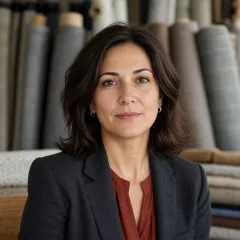
Lucia Bianchi
Lucia Bianchi is a woven apparel-fabric analyst covering cotton, linen, wool, rayon, denim, shirting, twill, satin, poplin, and blended garment fabrics. She applies the ISO 1833 series for fibre composition and ISO 105-C06 for laundering colourfastness while checking GSM, yarn count, usable width, shrinkage, skew, shade grade, drape, and surface defects. Her specification guides help designers, sourcing teams, and mills align fibre claims, lab dips, bulk tolerances, care conditions, and garment performance before production approval.